Last updated 2026-07-27
TL;DR
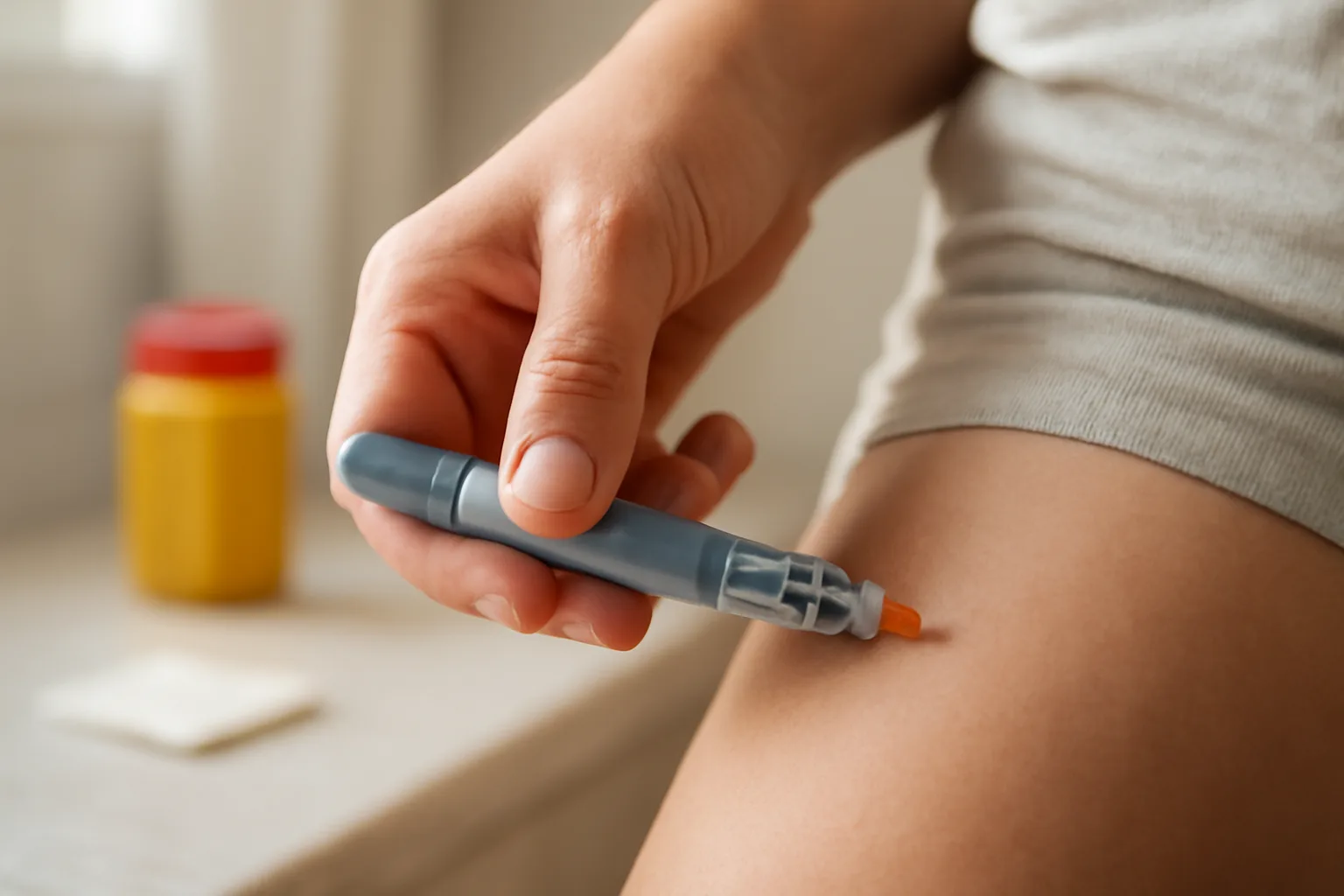
Tirzepatide is given as a once-weekly subcutaneous injection into the abdomen, thigh, or upper arm, using a fine needle (usually 4mm to 8mm, 29-31 gauge) held at a 90-degree angle. Rotate sites weekly, inject into clean, dry skin away from the navel, and let the pen or syringe reach room temperature first. Never inject into scar tissue, bruising, or muscle.
How do you actually inject tirzepatide, step by step?
The mechanics are simple once you've done it twice. Wash your hands. Pull the pen or vial out of the fridge 15 to 30 minutes ahead of time so the liquid isn't cold going in (cold injections sting more). Pick a site on your abdomen, thigh, or the back of your upper arm. Clean the skin with an alcohol swab and let it air dry for a few seconds; injecting through wet alcohol stings. Pinch a fold of skin if you're using a shorter needle, or skip the pinch if you're using an 8mm needle and have average body fat. Insert the needle at a 90-degree angle straight in. Push the plunger (or, with an auto-injector pen like the Zepbound or Mounjaro pen, hold it against the skin until you hear or feel the click sequence complete). Hold for 5 to 10 seconds after the dose delivers, then withdraw. Don't rub the site hard afterward. A light press with clean gauze if there's a drop of blood is enough. Log the date and site so you rotate correctly next week. That's the whole procedure. The FDA-approved labeling for Zepbound describes it plainly: inject subcutaneously once weekly, in the abdomen, thigh, or upper arm [1].
Where on the body should you inject tirzepatide?
The three approved and studied sites are the abdomen, the thigh, and the back of the upper arm [1]. All three showed comparable absorption in pharmacokinetic work supporting the tirzepatide label, so there's no site that gets the drug into your system meaningfully faster or slower in a way that matters clinically. Most people rotate through the abdomen (staying at least 2 inches from the navel) and the front or outer thigh, since the upper arm is hard to self-inject without help pinching the skin. If someone else is giving you the shot, the upper arm becomes a real option. Avoid the exact same quarter-inch spot week after week. Repeated hits to one patch of skin raise the odds of lipohypertrophy, a lumpy, thickened area under the skin that can also blunt absorption over time (this is documented with other subcutaneously injected peptides like insulin, and the mechanism is the same for tirzepatide). Move at least an inch or two from the last injection point, and cycle through zones over a month rather than reusing the same one two weeks running. For a full rotation map by week and body zone, see Tirz Rx injection sites.
What needle size and gauge do you need?
For subcutaneous injections in the belly or thigh, a 4mm to 6mm needle at 31 or 32 gauge is standard and what most compounding pharmacies ship with tirzepatide vials. The manufactured pens (Zepbound, Mounjaro) use a fixed, concealed needle you never see, roughly 5mm to 8mm depending on the device generation, engineered specifically for subcutaneous depth regardless of body type [1]. If you're drawing from a multi-dose vial with an insulin syringe, 29 to 31 gauge, 0.5 inch (12.7mm) or shorter, is the common range people use, though the exact needle that comes packaged depends on your pharmacy. Thinner gauge (higher number) means a finer needle and less pain on entry, at the cost of a slightly slower draw. For most adults, a 6mm needle at a 90-degree angle reaches the subcutaneous fat layer without hitting muscle. Very lean individuals sometimes pinch the skin and inject at a 45-degree angle instead to avoid intramuscular placement.
How do you reconstitute tirzepatide before injecting it?
This step only applies to compounded tirzepatide that ships as a lyophilized (freeze-dried) powder, not to the FDA-approved Zepbound or Mounjaro pens, which arrive pre-mixed and ready to use [1]. If you have powder, you add a specific volume of bacteriostatic water to hit a target concentration, mix gently (never shake, it can degrade the peptide), and let it sit until fully clear. Getting the concentration math wrong is the single most common dosing error people report with compounded product, because it changes how many units on the syringe equal your intended milligram dose. We cover the full mixing ratios, water volumes, and unit math separately: how to reconstitute Tirz Rx. Once reconstituted, refrigerate the vial and use it within the timeframe your pharmacy specifies, generally measured in weeks, not months. Discard anything cloudy, discolored, or past its labeled stability window.
What dose do you start with and how does it increase?
The FDA-approved starting dose for both Zepbound (weight management) and Mounjaro (type 2 diabetes) is 2.5mg once weekly for 4 weeks. This initial dose is not meant to produce meaningful weight loss or glucose control; it exists to let the gut adjust and reduce nausea [1][2]. After 4 weeks, the dose steps up to 5mg weekly. From there, if needed and tolerated, it can increase in 2.5mg increments every 4 weeks up to a maximum of 15mg weekly [1]. In the SURMOUNT-1 trial (NCT04184622), participants titrated to either a 10mg or 15mg maintenance dose over 20 weeks and lost an average of 15.0% (10mg) or 20.9% (15mg) body weight at 72 weeks versus 3.1% on placebo [3]. In SURPASS-2 for type 2 diabetes (NCT03987919), tirzepatide at 5mg, 10mg, and 15mg all outperformed semaglutide 1mg on HbA1c reduction at 40 weeks [4]. Slower or faster titration is sometimes used clinically depending on GI tolerance, but jumping doses faster than every 4 weeks isn't how the drug was studied and raises side effect risk without clear benefit. For the full week-by-week schedule and how to handle a missed dose or plateau, see Tirz Rx dosage and the Tirz Rx dosage calculator.
How often do you inject tirzepatide?
Once weekly, same day each week, roughly the same time of day if that's convenient, though the label doesn't require a strict hour window. You can take it with or without food. The long half-life (about 5 days) is exactly why weekly dosing works instead of daily. If you want the pharmacokinetic detail on why the interval is 7 days and how much wiggle room you actually have, see Tirz Rx half life. If you miss a dose, the Zepbound label instructs administering it within 4 days (96 hours) of the missed dose; if more than 4 days have passed, skip that dose and resume your normal weekly schedule on the next scheduled day [1]. Don't double up to make up for a missed shot.
Do you pinch the skin, and what angle do you inject at?
For most adults using a 4mm to 6mm needle, no pinch is needed and a 90-degree (straight in) angle works. If you're very lean, using a longer needle, or injecting into the thigh where there's less fat padding, pinching a fold of skin and injecting at a 45-degree angle reduces the risk of hitting muscle. Hitting muscle isn't dangerous, but it changes absorption speed and tends to hurt more. If you routinely bruise or feel a sharp ache rather than a dull pressure, you're probably going in at too steep an angle or too deep for your body composition. Switch to the pinch-and-45-degree method and see if that resolves it.
What are the most common side effects after injecting?
Nausea, diarrhea, constipation, and vomiting are the headline GI side effects across every major tirzepatide trial, and they're dose-related, meaning they show up more at higher doses and mostly during titration weeks. In SURMOUNT-1, nausea was reported in about 24-33% of tirzepatide-treated participants depending on dose, versus about 10% on placebo, and discontinuation due to any adverse event occurred in roughly 4.3% to 7.1% of tirzepatide groups versus 2.6% on placebo [3]. Injection site reactions (redness, itching, mild swelling) happen but are far less common and usually resolve within a day or two. Fatigue and mild hypersensitivity reactions are also reported. None of this is unique to where or how you inject; it's the drug's mechanism, not a technique problem. Slower titration and injecting with food in your stomach sometimes takes the edge off nausea, though the evidence for that specific trick is more anecdotal than trial-proven.
What serious risks and contraindications do you need to know before injecting?
Tirzepatide carries a boxed warning for thyroid C-cell tumors, based on findings in rodent studies. The label states plainly: "Tirzepatide causes dose-dependent and treatment-duration-dependent thyroid C-cell tumors in rats... It is unknown whether tirzepatide causes thyroid C-cell tumors, including medullary thyroid carcinoma (MTC), in humans" [1]. Because of this, tirzepatide is contraindicated in anyone with a personal or family history of medullary thyroid carcinoma or Multiple Endocrine Neoplasia syndrome type 2 (MEN 2) [1][2]. Pancreatitis has been reported in clinical trials, though a causal link isn't firmly established; if you get severe, persistent abdominal pain, especially radiating to the back, stop and get evaluated. Gallbladder disease, including cholelithiasis and cholecystitis, showed up more often in tirzepatide-treated groups than placebo across the SURMOUNT program, likely related to rapid weight loss itself rather than a direct drug effect. Tirzepatide also isn't recommended during severe gastrointestinal disease, and it's contraindicated in anyone with a known hypersensitivity to tirzepatide or any component of the formulation [1]. Hypoglycemia risk rises meaningfully when tirzepatide is combined with insulin or sulfonylureas, so anyone on those needs a dose adjustment conversation with their prescriber before starting. None of these risks are things good injection technique can prevent; they're pharmacologic and require medical screening before you ever pick up a needle.
How is compounded tirzepatide different from Zepbound and Mounjaro?
Zepbound (approved for chronic weight management in adults with obesity or overweight plus a weight-related condition) and Mounjaro (approved for type 2 diabetes) are the only FDA-approved tirzepatide products, both manufactured by Eli Lilly, both delivered via pre-filled single-use pens with a fixed, hidden needle [1][2]. Compounded tirzepatide is prepared by a state-licensed compounding pharmacy, typically as a multi-dose vial you draw up yourself with a separate syringe and needle. It is not FDA-approved as a product, meaning the FDA has not verified its safety, efficacy, or manufacturing consistency for that pharmacy's specific batch the way it does for Zepbound and Mounjaro. Compounding is legal under certain conditions, generally tied to whether the drug is on the FDA's official shortage list, though tirzepatide came off that list in late 2024, which narrowed the legal basis for mass compounding considerably. The injection mechanics (site, angle, needle depth) are essentially the same either way. The difference is in sourcing, dose accuracy, sterility assurance, and regulatory oversight, not in how the needle goes into your skin. Anyone using compounded product should get it through a pharmacy that discloses its sourcing and testing, and ideally under review from a prescriber who's actually looking at your labs and history, more than filling an order.
How should you store tirzepatide between injections?
Unopened Zepbound and Mounjaro pens or vials belong in the refrigerator at 36°F to 46°F (2°C to 8°C) until first use [1][2]. Once you start using a pen, it can be kept at room temperature (up to 86°F/30°C) or refrigerated, and used within 21 days for Zepbound and up to 30 days for Mounjaro depending on formulation and pen type, per the manufacturer's storage instructions; check your specific pen's insert since this varies by dose strength and packaging lot. Never freeze tirzepatide. If a pen or vial has been frozen, discard it. Keep it away from direct light and heat (don't leave it in a hot car or on a sunny windowsill). Compounded vials generally need refrigeration throughout their use life and have shorter overall stability windows than the manufactured pens, often 28 to 60 days after reconstitution depending on the compounding pharmacy's testing and formulation, so always follow the label that specific pharmacy provides rather than assuming manufacturer timelines apply.
How do you know if you're injecting correctly, and what should you avoid?
You're doing it right if the needle goes in cleanly, there's minimal to no bleeding, and you feel a dull pressure rather than a sharp, electric pain (sharp pain can mean you've hit a nerve ending or gone too shallow and grazed the dermis). A small bruise now and then is normal. Frequent bruising, hard lumps, or persistent redness at old sites means you need to rotate further and possibly reconsider needle angle. Things to avoid: injecting into scar tissue, stretch marks, moles, or any area that's bruised, inflamed, or tattooed within the last several weeks. Don't inject through clothing. Don't reuse needles (they dull fast and compounding pharmacies typically ship single-use needles for exactly this reason). Don't inject into the exact same spot two weeks running. And don't skip the room-temperature warmup; injecting straight from the fridge is the single most avoidable cause of stinging that people mistake for a technique failure.
How does tirzepatide's injection protocol compare to semaglutide (Wegovy/Ozempic)?
| Mechanism | Dual GIP/GLP-1 receptor agonist | GLP-1 receptor agonist only | |
|---|---|---|---|
| Starting dose | 2.5mg weekly | 0.25mg weekly | |
| Max approved dose | 15mg weekly | 2.4mg weekly (Wegovy) | |
| Titration interval | Every 4 weeks | Every 4 weeks | |
| Injection frequency | Once weekly | Once weekly | |
| Avg. weight loss (72wk trial, high dose) | 20.9% (SURMOUNT-1, 15mg) [3] | 14.9% (STEP 1, 2.4mg) [5] | Both drugs carry the same thyroid C-cell tumor boxed warning and MEN2/personal-or-family MTC history contraindication [1][2][6]. If you're deciding between the two, the injection routine won't be the deciding factor; the dose-response data and your GI tolerance will be. |
Mechanically, they're nearly identical: both are once-weekly subcutaneous injections into the abdomen, thigh, or upper arm, both use similarly fine needles, and both come in pre-filled pens from their manufacturers (Lilly for tirzepatide, Novo Nordisk for semaglutide). The real differences are in the molecule and the dosing ladder, not the injection technique itself. | Feature | Tirzepatide (Zepbound/Mounjaro) | Semaglutide (Wegovy/Ozempic) |
Frequently asked questions
Can you inject tirzepatide into the same spot every week?
No. Reusing the exact same spot raises the risk of lipohypertrophy (lumpy, thickened skin) and can slow absorption over time. Move at least an inch or two from your last injection point and rotate between the abdomen, thigh, and upper arm across each month.
Does it matter what time of day you inject tirzepatide?
No. The label allows injection at any time of day, with or without food, once weekly. Consistency in the day of the week matters more than the hour, since it keeps your dosing interval close to 7 days, which is how the drug's roughly 5-day half-life was studied [1].
What happens if you inject tirzepatide into a muscle instead of under the skin?
It's not dangerous, but it can change absorption speed and usually hurts more than a proper subcutaneous shot. If you consistently feel sharp pain instead of dull pressure, pinch the skin and use a 45-degree angle instead of going straight in at 90 degrees.
Can you inject tirzepatide in your stomach near your belly button?
Stay at least 2 inches away from the navel. The area immediately around the belly button has denser scar-like tissue and can absorb medication less predictably. The rest of the abdomen, away from that zone, is a standard approved injection site [1].
How long does it take for tirzepatide to work after injecting?
You won't feel anything dramatic within hours. Appetite suppression and GI effects typically build over the first 1 to 2 weeks per dose level, and meaningful weight loss accumulates over months, with SURMOUNT-1 measuring outcomes at 72 weeks [3]. It is not a fast-acting injection.
Is it normal to bleed a little after injecting tirzepatide?
A tiny drop of blood or a pinpoint bruise is normal and not a sign of doing it wrong. Frequent bleeding, larger bruises, or pain that lasts more than a day or two suggests you should adjust your angle, needle depth, or rotate to a less-used site.
Can you inject tirzepatide cold, straight from the fridge?
You can, but it typically stings more. Most people let the pen or vial sit at room temperature for 15 to 30 minutes before injecting. This isn't a safety requirement, just a comfort one, and it's the most common fix for unexplained injection pain.
What needle size is used for compounded tirzepatide versus the Zepbound pen?
Zepbound and Mounjaro pens use a fixed, hidden needle you never see, generally in the 5mm to 8mm range depending on device version [1]. Compounded tirzepatide from a vial is typically drawn up with a 29 to 31 gauge insulin syringe with a 4mm to 6mm needle, though this varies by pharmacy.
Do you need to prime the needle before injecting tirzepatide from a pen?
The manufactured Zepbound and Mounjaro auto-injector pens don't require manual priming; the device handles needle deployment and dose delivery internally when triggered against the skin [1][2]. If you're using a vial and separate syringe, you do need to expel air bubbles from the syringe before injecting.
How many times can you use one tirzepatide pen?
Each Zepbound and Mounjaro pen is single-use and pre-filled with one weekly dose; you use it once and discard it in a sharps container [1][2]. Compounded product from a multi-dose vial is used across several weeks, drawn up fresh each time with a new syringe and needle.
What should you do with used tirzepatide needles and pens?
Dispose of them in an FDA-cleared sharps container, never in household trash or recycling. Once a container is about three-quarters full, seal and dispose of it per your local household hazardous waste guidelines; many pharmacies and health departments offer take-back programs.
Can someone else inject tirzepatide for you?
Yes. A partner, caregiver, or clinician can administer the injection using the same technique: clean skin, correct angle for the needle length, and rotation through approved sites. This is common for the upper arm site, which is harder to reach and pinch for a self-injection.
Sources
- FDA, Zepbound (tirzepatide) prescribing information: Zepbound dosing schedule, injection sites, boxed warning language, storage instructions, missed dose guidance
- FDA, Mounjaro (tirzepatide) prescribing information: Mounjaro dosing schedule, contraindications, storage guidance for type 2 diabetes indication
- NEJM, SURMOUNT-1 trial (Jastreboff et al., 2022): SURMOUNT-1 (NCT04184622) weight loss percentages at 72 weeks and adverse event/discontinuation rates by dose
- NEJM, SURPASS-2 trial (Frias et al., 2021): SURPASS-2 (NCT03987919) comparison of tirzepatide versus semaglutide 1mg on HbA1c reduction
- NEJM, STEP 1 trial (Wilding et al., 2021): Semaglutide 2.4mg weight loss percentage at comparable trial duration for cross-drug comparison
- FDA, Wegovy (semaglutide) prescribing information: Semaglutide dosing ladder, max approved dose, and thyroid C-cell tumor boxed warning for cross-drug comparison